Portfolio

Real problems.
Measurable outcomes.

These cases are anonymized by client name where appropriate, but accurate in scope, constraints, approach, and outcome. They represent the problems this work addresses and what actually changes when the knowledge architecture is right.

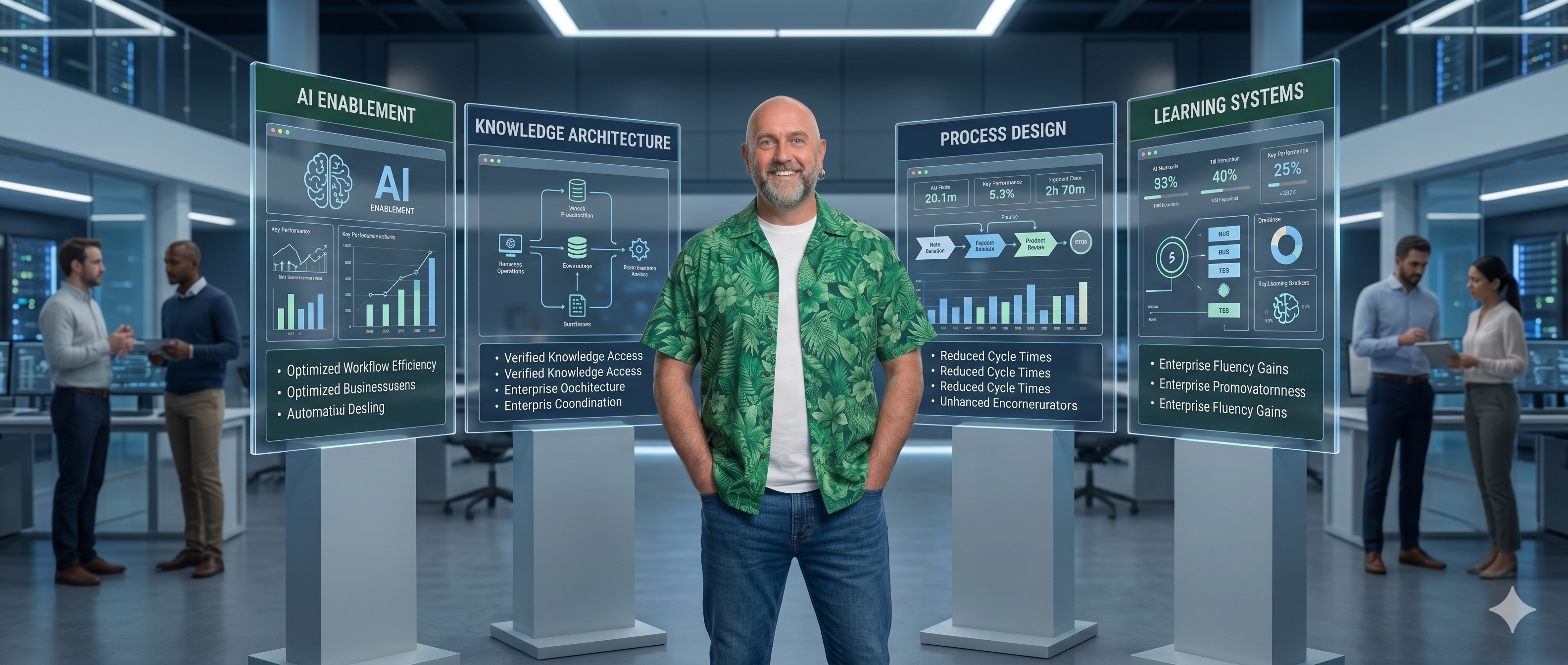
Portfolio hero image showing Josh surrounded by enterprise outcome panels representing AI enablement, knowledge architecture, process design, and learning systems.
Real work, real systems, and measurable outcomes across AI enablement, knowledge architecture, process design, and learning.

AI Enablement

Financial Services AI Fluency 8,568 Employees

Enterprise AI fluency program — large-scale financial services organization

Context

A major financial services organization began enterprise AI tool deployment. Leadership needed measurable adoption — not just access — across a large and distributed employee base with varying levels of digital fluency.

Problem

Employees had access to AI tools but weren't using them effectively. Early adoption patterns showed surface-level use — copy-paste, simple queries — with no progression toward operational integration. Standard training approaches weren't producing sustained behavior change.

Constraints

Enterprise scale (8,568+ employees), regulated environment requiring governance-aligned content, distributed teams across time zones, and a hard deadline for measurable adoption outcomes.

My Role

Designed and led the program from framework development through deployment and measurement. Developed the content infrastructure, trained facilitators, established adoption metrics, and monitored 45-day retention outcomes.

What I Built

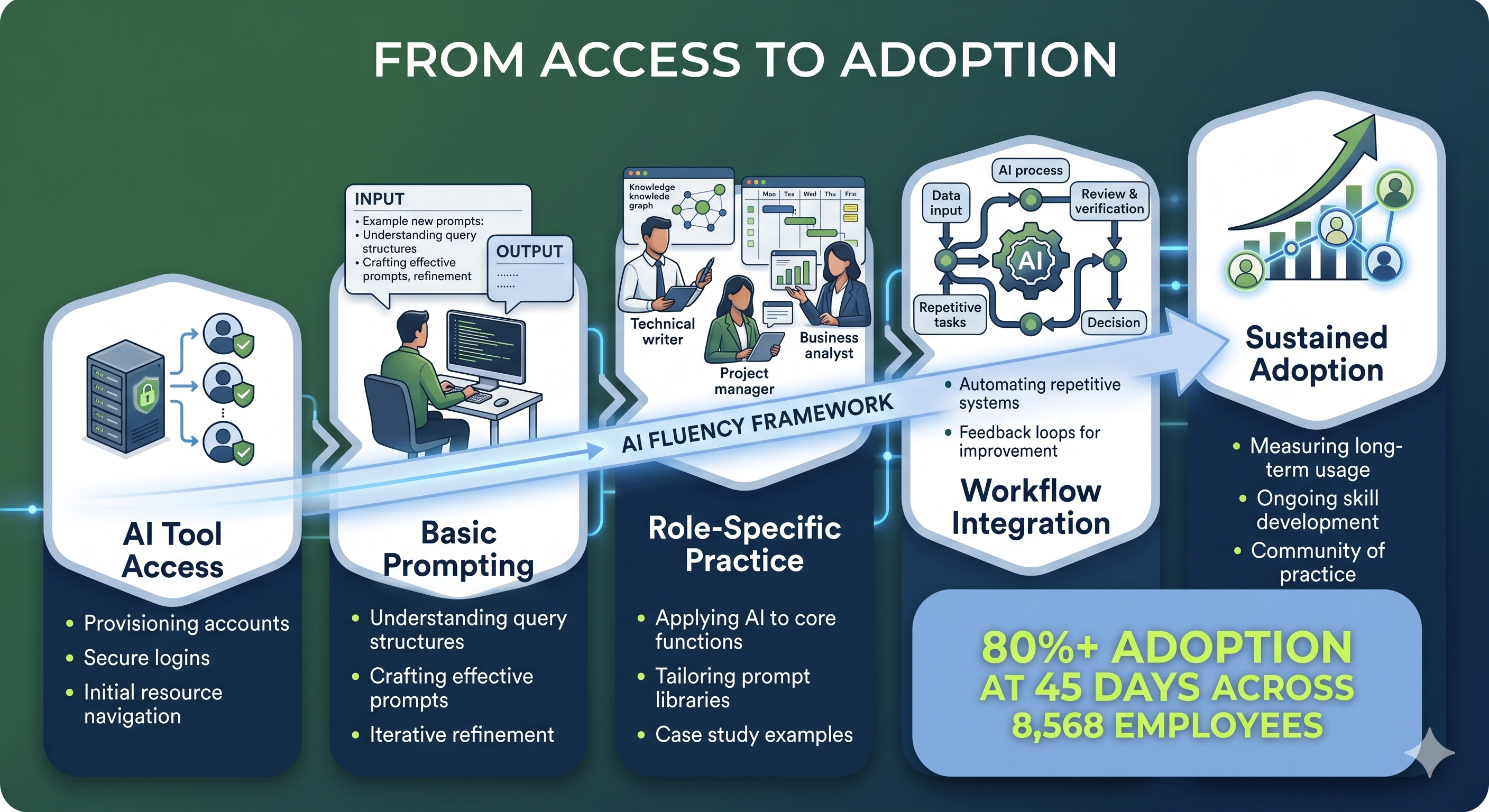
A structured AI fluency program built around the Crawl / Walk / Run / Fly adoption framework. Phase-based training from basic prompt construction through workflow integration, with role-specific tracks and governance-aligned guardrails built in.

Impact

80%+ AI tool adoption at 45 days across 8,568 employees. Program deployed in roughly half the originally projected timeline. Adoption was sustained — not just initial login rates — measured through active usage metrics at 45-day intervals.

What it proves: AI adoption doesn't stall because people resist technology. It stalls because the learning framework isn't designed for how change actually happens at scale.
Infographic showing the progression from AI tool access to basic prompting, role-specific practice, workflow integration, and sustained adoption.
AI adoption does not happen when people get access to a tool. It happens when they learn how to use it inside real work.
Enterprise Technology Content Architecture AI Retrieval

AI content pipeline redesign — large-scale technology organization

Context

A large technology organization deployed enterprise AI tools for employee support and internal operations. Initial deployment showed inconsistent performance that leadership struggled to diagnose.

Problem

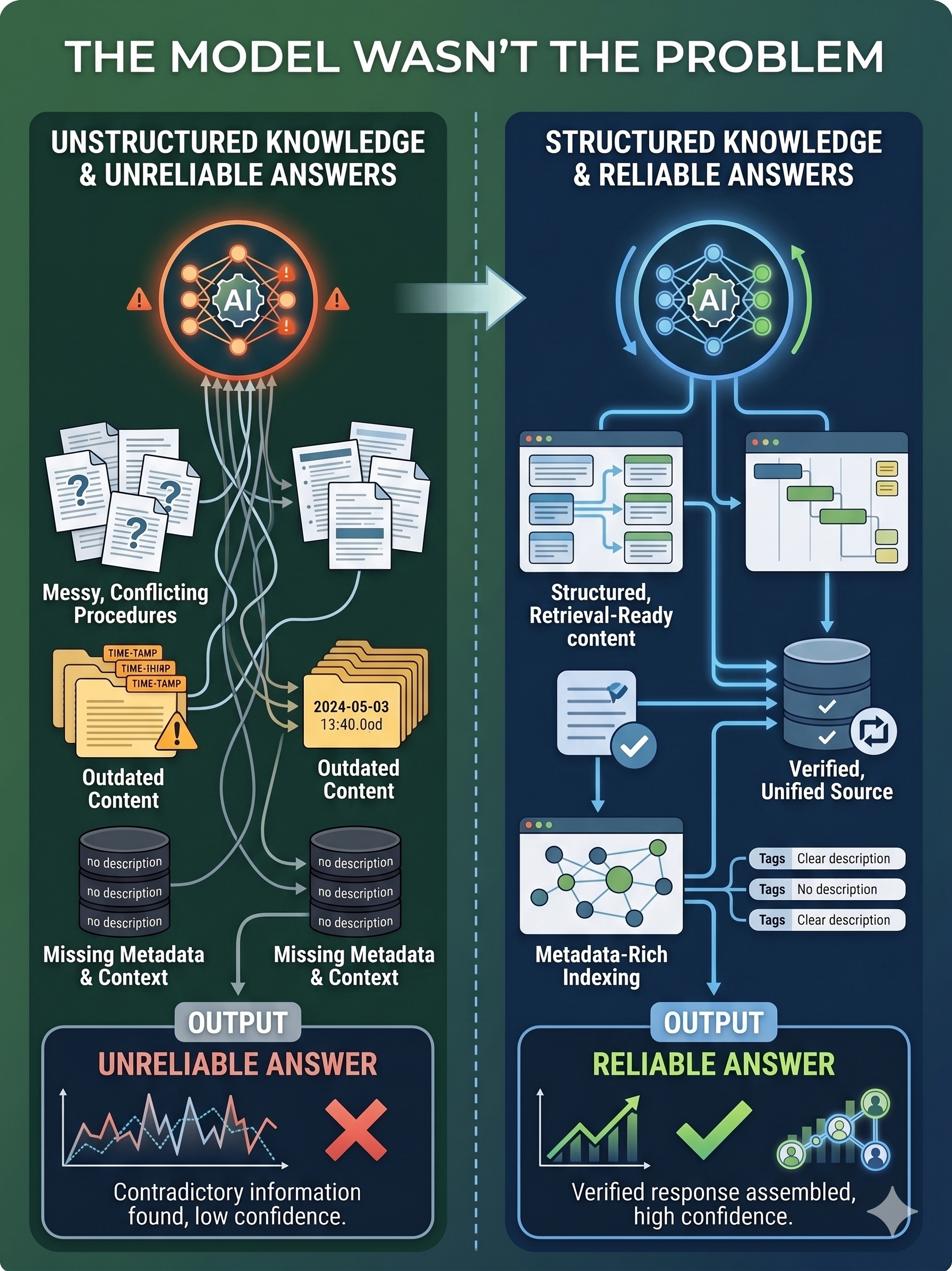
The AI system returned outdated procedures, conflicting answers, and failed to surface relevant content reliably. Employees were losing trust in the tool. The diagnosis kept pointing to the model, but the model wasn't the problem.

Constraints

Cannot swap out the retrieval system mid-deployment. Content teams needed to keep producing while the architecture was being redesigned. Solution had to be maintainable without ongoing manual curation.

My Role

Diagnosed the real problem (content architecture, not the model), redesigned the content structure feeding the system, built the metadata layer, and established the governance standards that maintain AI-readiness going forward.

What I Built

Retrieval-ready content formatting standards, a metadata layer providing role, task, and recency context to the retrieval system, structured prompting standards for content authors, and automated QA workflows that flag AI-readiness issues before content is published.

Impact

Measurable improvement in AI retrieval accuracy. Content delivery time reduced by 25% with increased message precision. The architecture established a sustainable model for ongoing content creation that maintains AI readiness without manual curation overhead.

What it proves: Most enterprise AI underperformance is a content architecture problem, not a model problem. Fix the layer the AI reads from, and the model performs.
Split-screen infographic showing unreliable AI answers from messy source content compared with reliable AI answers from structured, retrieval-ready knowledge.
When AI gives weak answers, the problem is often the knowledge environment feeding it.

Knowledge Architecture

Financial Services Post-Merger Integration 11,000+ Employees

Enterprise knowledge continuity across a large-scale financial services merger

Context

Two major financial services organizations merged, each with years of distinct documentation, process libraries, and knowledge repositories. The combined entity needed a unified operational knowledge base for 11,000+ employees without a rebuild from scratch.

Problem

Employees were operating with conflicting procedures. The same process existed in multiple versions across both organizations' legacy systems with no reliable way to determine which version was authoritative — or even current.

Constraints

Operations had to continue during the transition. No system downtime. Both legacy organizations had strong content ownership cultures that required careful stakeholder management. Governance standards had to work for both teams from day one.

My Role

Designed the cross-organizational knowledge communication pathways for the Technology and Enterprise Operations division. Led the architecture and integration work from discovery through handoff.

What I Built

Structured content systems to align and consolidate two knowledge ecosystems. A metadata-driven architecture that resolved version conflicts and established authority at the content level rather than requiring manual review. Cross-organizational governance model with clear ownership, review cycles, and conflict resolution rules.

Impact

Frictionless employee transitions across the merged organization. A single authoritative source for operational content serving 11,000+ employees. AI-assisted pipeline reduced communication delivery time by 25%.

What it proves: Post-merger knowledge chaos is an architecture problem, not a process problem. Building authority into the content structure eliminates the ambiguity that manual reconciliation can never fully resolve.
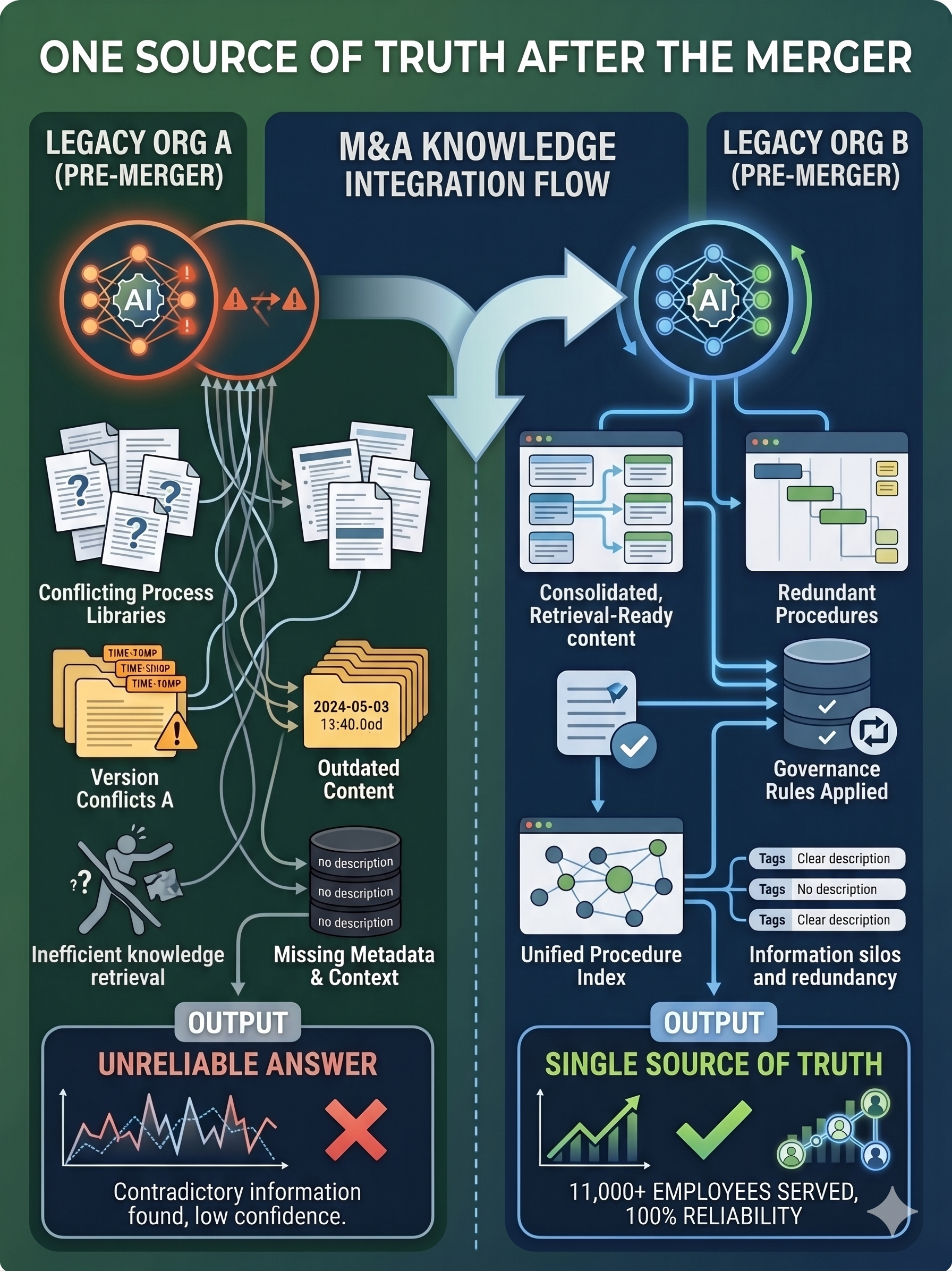
Infographic showing two legacy knowledge ecosystems merging into one governed source of truth after an organizational merger.
Post-merger knowledge work succeeds when conflicting libraries become one governed source of truth.
Enterprise Operations Governance Design Multi-Channel

Enterprise content governance model for a multi-channel knowledge ecosystem

Context

A large enterprise had content distributed across multiple platforms — intranet, knowledge base, LMS, SharePoint, and department-level repositories — with no unified governance and no mechanism for detecting version conflicts across channels.

Problem

The same information existed in different versions across systems with no defined ownership, no review cycle, and no way to resolve conflicts other than escalation. Employees had learned to distrust the knowledge system and defaulted to asking colleagues instead.

Constraints

Governance couldn't create more process than it prevented. The solution had to work for operational teams who weren't content professionals and couldn't absorb a significant new administrative burden.

My Role

Designed the multi-channel editorial operations model, the governance framework, the data instrumentation strategy, and the handoff process for sustainable internal operation.

What I Built

A multi-channel editorial operations model with defined ownership, review workflows, and data-driven engagement tracking. Governance standards that applied consistently across platforms while preserving the operational flexibility each channel required. Instrumentation that surfaced content performance without manual monitoring.

Impact

Elimination of conflicting content across channels. Measurable improvement in knowledge adoption metrics. The governance model scaled as the organization added new channels and content types without requiring proportional increases in oversight overhead.

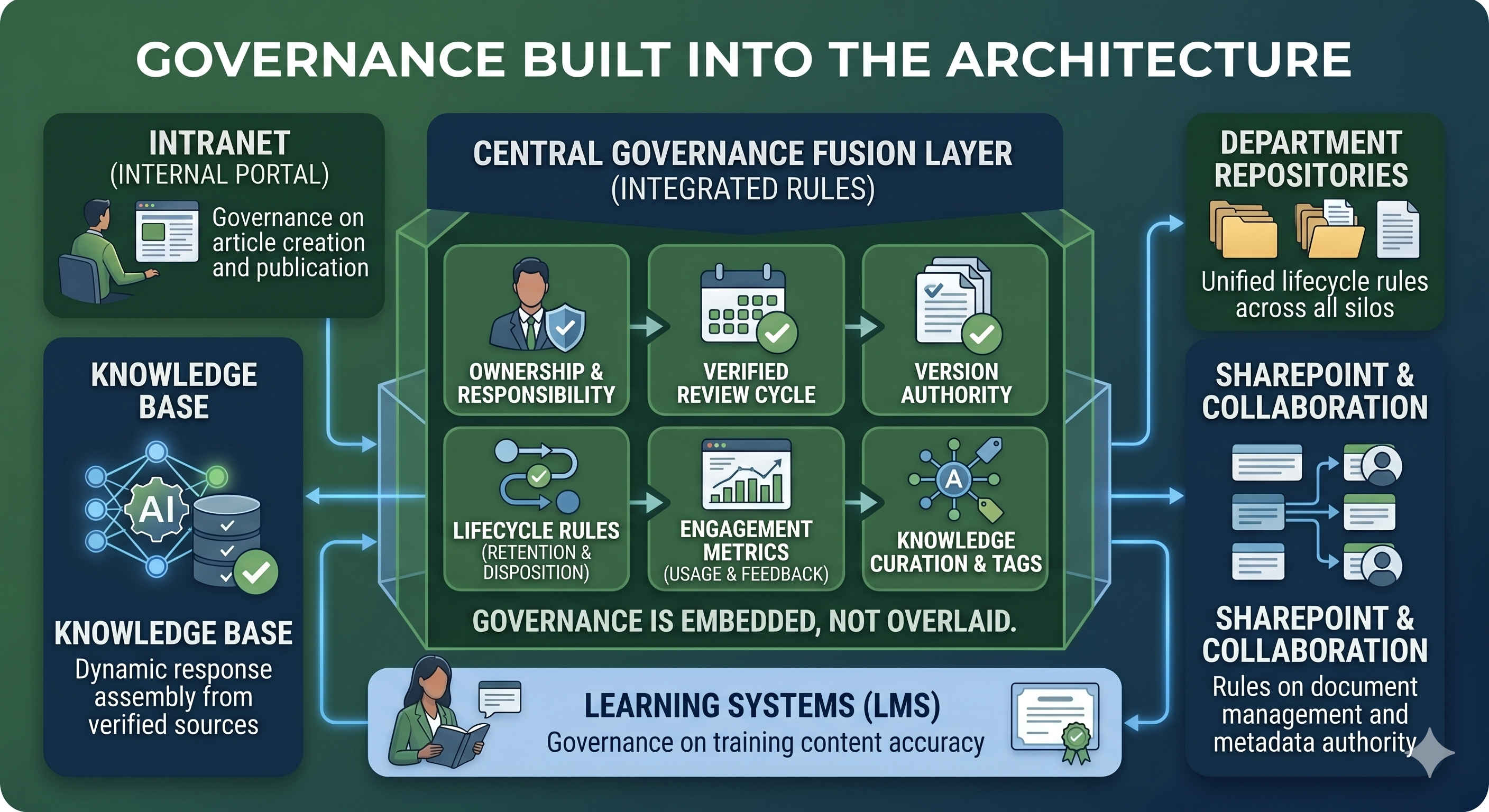
What it proves: Governance fails when it's designed as an oversight function. It succeeds when it's designed as an architectural property — built into the content structure rather than layered on top of it.
Diagram showing multiple enterprise content channels connected through a governance layer with ownership, review cycles, version authority, lifecycle rules, and metrics.
Governance works when it is built into the architecture, not bolted on after content has already drifted.

Process & Playbook Design

These engagements are represented by writing samples rather than full case studies. Each sample demonstrates how operational knowledge is structured for execution under pressure.
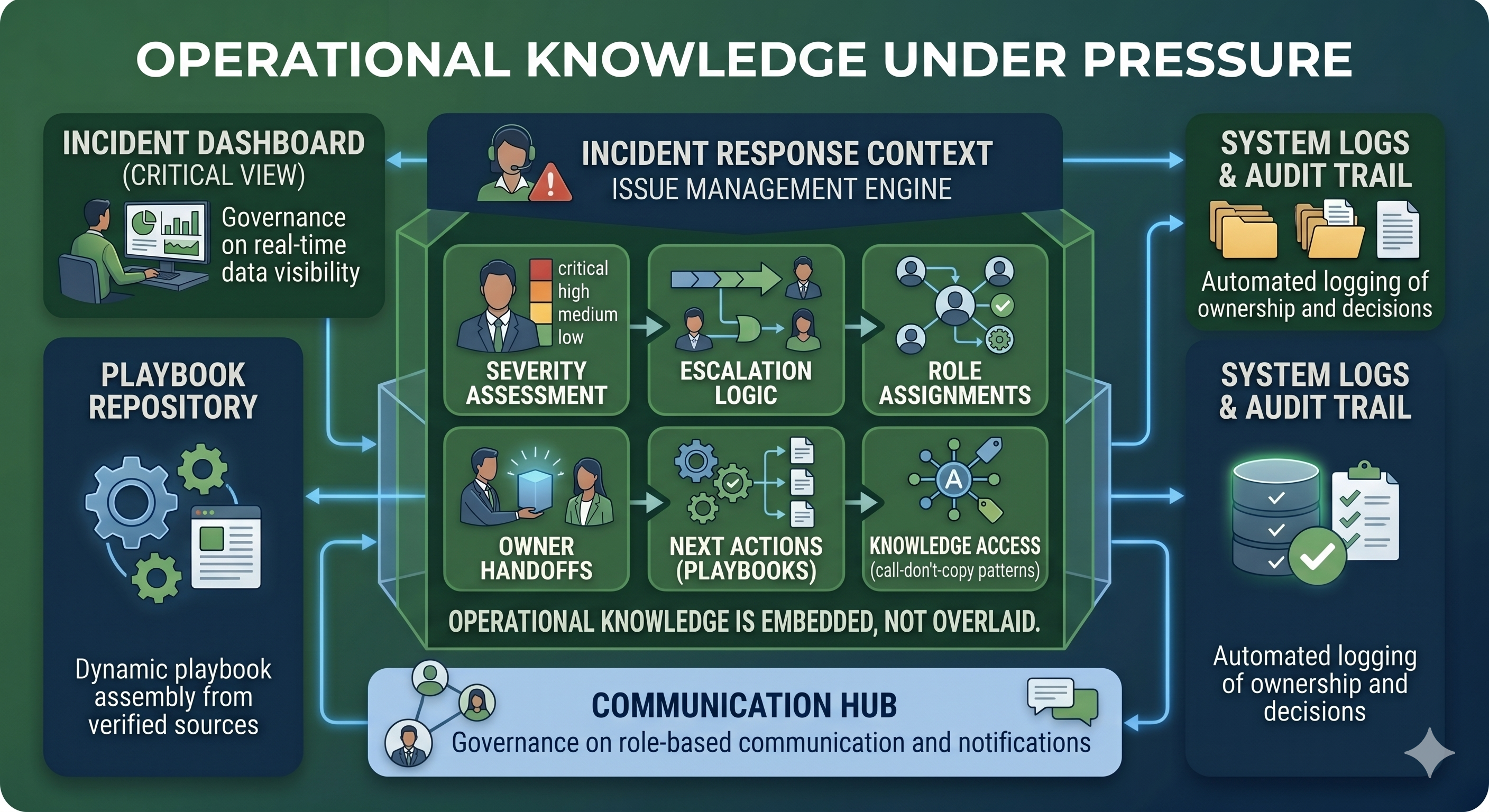
Enterprise operations visual showing severity levels, escalation paths, role assignments, handoffs, and next actions for work under pressure.
Operational knowledge has to be structured for the moment people need it, especially when pressure is high.

Learning & Development

Financial Services Onboarding Regulated Environment

Structured onboarding knowledge system for a regulated financial environment

Context

A regulated financial services organization had an onboarding process built entirely on tribal knowledge transfer from senior employees. New hire performance varied dramatically depending on which senior employee they happened to be assigned to.

Problem

Long, inconsistent time-to-competency across teams. Compliance risk created when experienced employees left. No durable knowledge base that could survive personnel changes. The organization kept re-onboarding the same knowledge from scratch with each new hire cohort.

Constraints

Regulated environment with strict content requirements. Content had to be accurate to policy, not just useful in practice. LMS integration required. No disruption to existing operations during build.

My Role

Designed and built the complete onboarding knowledge system from discovery through deployment and governance handoff. Defined the content types, built the LMS information model, created the governance rules, and trained the team that would maintain it.

What I Built

A structured onboarding knowledge system with defined content types for policy, process, procedure, and reference material. An LMS information model aligned to those types. Governance rules for content review, maintenance, and lifecycle management. A handoff package the internal team could operate without external support.

Impact

40% reduction in onboarding time-to-competency. Consistent outcomes across teams, regardless of the assigned manager or cohort. Compliance risk from knowledge concentration significantly reduced. The system survived three personnel changes in the first year without requiring a rebuild.

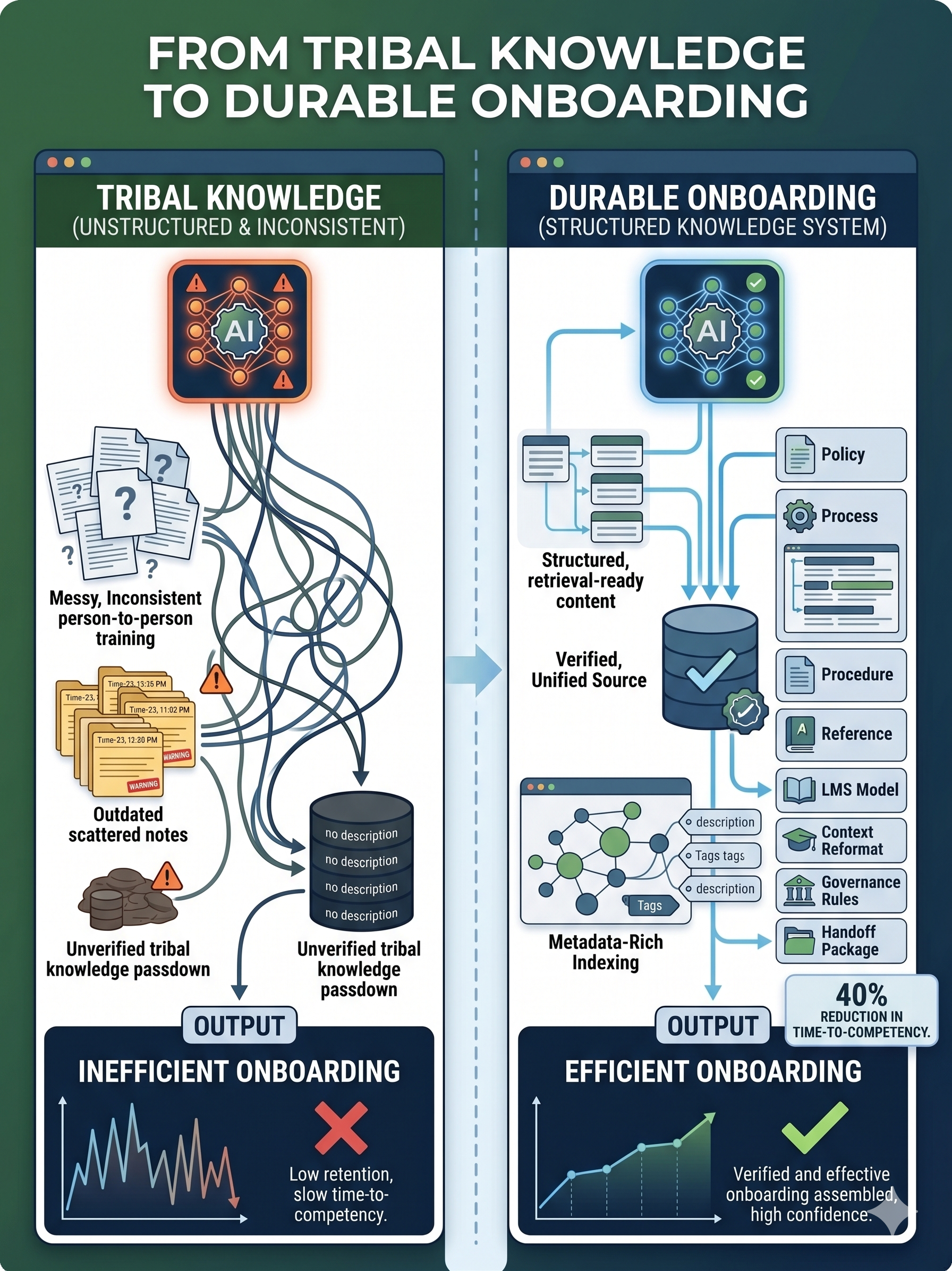
What it proves: Inconsistent onboarding is a structural problem. When knowledge is tribal, outcomes are only as good as the last person who held it. Structure makes consistency possible — and compliance achievable by design.
Before-and-after infographic showing tribal knowledge and scattered notes becoming a structured onboarding system with policies, processes, procedures, references, LMS content, and governance.
Durable onboarding turns expert memory into a system new people can actually use.

Selected Outcomes

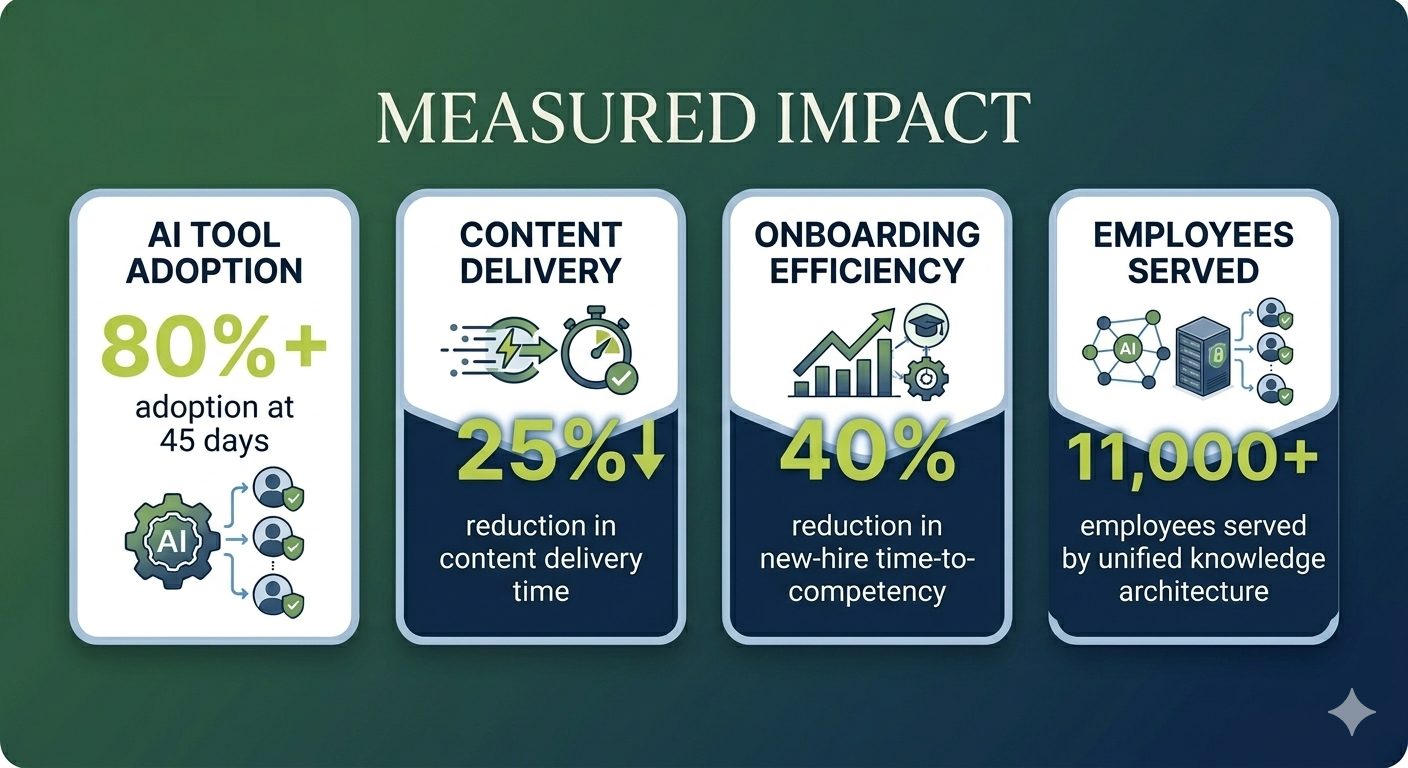
Measured impact dashboard showing 80%+ AI tool adoption, 25% reduction in content delivery time, 40% reduction in new-hire time-to-competency, and 11,000+ employees served.
Selected outcomes across AI adoption, content delivery, onboarding, and enterprise knowledge architecture.
80%+
AI tool adoption at 45 days across 8,568 employees in an enterprise financial services AI fluency program. Deployed in roughly half the projected timeline.
25%
Reduction in content delivery time with increased precision, via AI-assisted pipelines built for the Technology and Enterprise Operations division.
40%
Reduction in new-hire time-to-competency through a structured onboarding knowledge system in a regulated financial environment.
11,000+
Employees served by a unified post-merger knowledge architecture with a single authoritative source across two previously distinct knowledge ecosystems.

Looking for writing samples?

The portfolio cases above focus on project outcomes. The writing samples section shows the actual documents, playbooks, and frameworks that represent the craft behind the work.